
I AM • The Future and The Past
I do not know who I am.
I will become who I am meant to be.
I am the future that, one day, will become the past.
We never choose the place where we are born. It is a mystery that welcomes us without asking anything of us, an enigma that reveals its meaning only as time passes.
For better or for worse, that place becomes the starting point of our existence: the crossroads where our first thoughts, first emotions, and first experiences take shape.
It is there that my soul begins its journey, shaped by everything that surrounds it: the colors, the sounds, the faces, and even the silence that inhabits that place.
It is not merely a setting, but a quiet and constant presence that accompanies my growth, shaping the way I am, the way I feel, and the way I live. It is there that, day by day, I become who I am—an individual, unique and unlike any other.
I ask only this: leave me a place where Nature can watch over me, where I can find refuge, strength, and hope. A corner of the world where the wind whispers ancient stories to me, where the sun warms me, and the earth supports me.
Only in that place will I be free to grow, to discover who I truly am, and to follow the destiny that awaits me.


Hommage to Misha Gordin
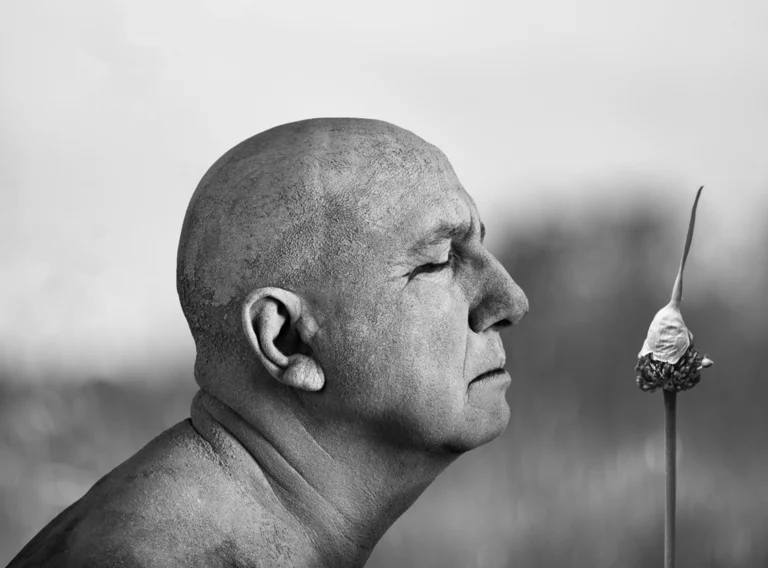
“Do I point my camera toward the world that exists, or do I turn it inward, toward my own soul?”
It is a question in which I deeply recognize myself.
My need to explore my inner world resonates with a mental and conceptual affinity that feels remarkably close to that of Misha Gordin. It is as though my way of understanding photography has always walked alongside his—or perhaps his alongside mine.
These are thoughts that delve into the depths of the soul, dissolving every uncertainty and revealing, with clarity, the path I am meant to follow. It is a form of photography that seeks not merely to depict the world, but to question existence itself, transforming every image into a meditation on what it means to be human.
If I were to describe this feeling through a metaphor, I would compare it to a science fiction film in which clones, living in different parts of the world, are destined to follow the same path. Without ever meeting, they share the same vision, the same sensitivity, and the same irresistible need to seek, through
The Silence of Man
Dedicated to all Indigenous Peoples of Planet Earth


INFRARED
Photographs created with this technique alter the way we are normally used to seeing, revealing a reality that is rarely perceived yet visually striking and immersive.
These images are taken predominantly in nature, where vegetation becomes a central presence, transforming the green of the leaves into snow-white tones. The skies gain a profound atmospheric density, with luminous white clouds that intensify the contrast and shape the composition of each frame.


“SAVE NATURE”
A world in collapse, where survival becomes the only law. Gas masks define human identity as nature slowly disappears under its own exploitation.
In contrast, the figure of a young girl moves through the images as a fragile yet essential presence: not only innocence, but the possibility of a future.
Between reality and vision, the project reflects on a civilization that has lost its connection to life, and raises an urgent question: how much longer can what is alive endure?
What are we supposed to do?


“CHILDREN OF NAIROBI”
A photographic project dedicated to the street children of Nairobi, many of whom are orphans or lack any stable family support, forced to grow up in conditions of extreme marginalization.
Their lives unfold among landfills and streets, where daily survival depends on collecting plastic, glass, and other materials to be sold for a few cents. In this environment, hunger and instability are not occasional events but a constant condition.
To escape reality, some children use easily accessible inhalants such as industrial glues and other toxic substances, entering altered states that temporarily numb hunger and despair, but accelerate both physical and mental decline.
The project is based on the observation of documentary materials and journalistic testimonies that have brought this reality to light.
The images aim to present a direct, non-spectacularized view of an extreme condition, where childhood exists between fragility, adaptation, and resilience.


PAPERMAN
A series of images exploring the fragility of the human being, constantly exposed to the pressures of contemporary reality.
Everyday threats hide within pre-packaged choices and the dynamics of mass media, which spread constructed messages repeated until they become perceived as truth. A subtle and continuous influence that can distort awareness and distance us from reality.
The use of newspaper clippings as a visual disguise becomes a symbol of this layered information: a surface that covers and shapes thought, gradually reducing clarity and freedom of perception.
Each photograph, built through bodily expression, becomes a direct visual language. The images address universal themes such as ignorance, courage, abuse, friendship, fake news, racism, awareness, nature, and childhood.
Each shot is accompanied by short captions that reinforce the meaning of the gesture, creating an immediate dialogue between body and concept.
The project is completed by quotations from major literary authors, amplifying the meaning of the images and giving words to visual silence.


Three Wise Monkeys
We bring the Earth before our eyes to admire its beauty, yet often we see only our own selfishness. Numbed by the inertia of the system, we grow resigned to the loss of change. The Earth, once a source of wonder, now struggles for survival under the weight of human neglect.
Still, there is hope: no one is truly deaf who does not wish to listen. We bring the Earth to our ears to hear the wind, the rain, and the sea breaking on the shore. Even as the voices of animals fade, we can still sense their presence and the urgency of their survival.
Finally, we bring the Earth to our senses, to feel and breathe its essence. Perhaps this is the last moment before we lose contact with it completely—yet it continues to call us, asking us to awaken and take responsibility for its protection.


STILLS


INTEGRALI


about me

Born in Venice in the early 1960s.
For me, photography is an extension of thought and body: a language through which light becomes experience and perception.
My practice moves between historical techniques and contemporary experimentation. I combine processes such as pinhole photography, large and medium format, darkroom printing, cyanotype, and wet collodion with early 20th-century lenses, found materials, and self-built devices.
Through infrared photography, I explore a parallel reality suspended between the visible and the invisible, while the construction of photographic tools becomes part of the creative process itself.
Black and white is my essential choice: a space of reduction and clarity, where photography returns to its most direct and fundamental form.
Ettore Belgrado, Venice July 2026